KLIK SAJA - U.S. President Donald Trump has reportedly approved initial plans for a military strike on Iran, though he is still considering whether to give the final go-ahead.
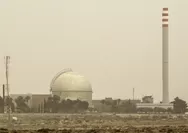
At the heart of the plan lies the Fordo nuclear enrichment site—an underground facility that plays a critical role in Iran’s nuclear ambitions.
According to military analysts, the United States remains the only country with the capability to effectively destroy the fortified facility.
Despite the mounting pressure, Trump has remained deliberately vague about his intentions.
Speaking to journalists, he stated, "I may do it, I may not do it. Nobody knows what I’m going to do. But I can say this: Iran is in a lot of trouble and wants to negotiate."
Meanwhile, Iranian Foreign Minister Abbas Araghchi is scheduled to meet with British, German, and French counterparts in Geneva on Friday in a diplomatic effort to ease the rising tensions.
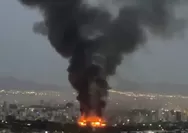
On another front, Israel continues its escalating campaign of airstrikes deep into Iranian territory, launching attacks in Tehran.
Authorities have also issued evacuation warnings to residents of Arak and Khandab—an ominous sign of a potentially massive regional conflict on the horizon.
Amid growing speculation that the U.S. might join Israel in its military offensive, Washington has begun re-positioning strategic assets to the Middle East in preparation for possible engagement.
A senior U.S. official confirmed that around 40,000 American troops are currently stationed across the region.
More than 30 U.S. military tanker aircraft, essential for mid-air refueling of bombers and fighter jets, have recently been redeployed from domestic bases to Europe.
The aircraft carrier USS Nimitz is en route from the South China Sea to the Middle East, accompanied by several guided-missile destroyers.
Other U.S. warships are already stationed in the Persian Gulf and Gulf of Oman, with some reportedly assisting Israel in intercepting Iranian missile attacks.
In addition, advanced U.S. fighter jets—including the F-16, F-22, and F-35—have been deployed to air bases across the Middle East, signaling Washington’s full military readiness should an order to strike be issued, Reuters reports.