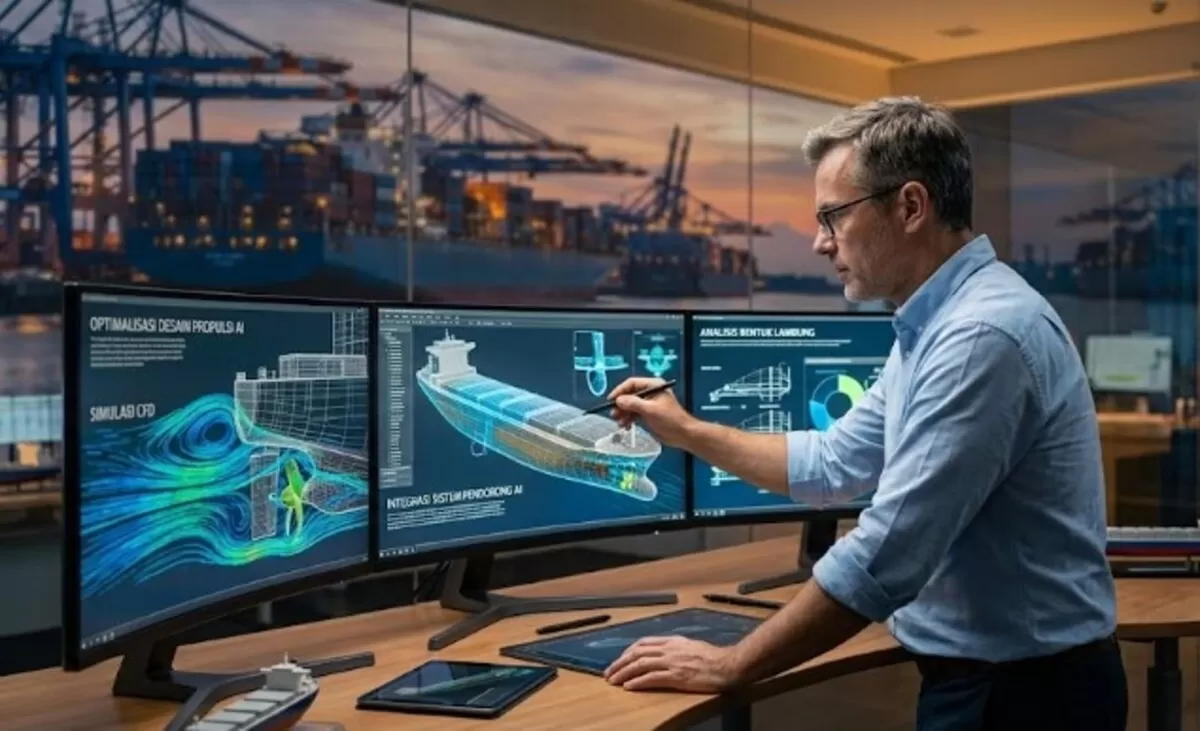
KLIK SAJA - Like professionals in many other engineering disciplines, experts focusing on marine propulsion systems are increasingly recognizing the benefits of Artificial Intelligence (AI) and Machine Learning (ML) in enhancing productivity, improving documentation consistency, and supporting data-driven decision-making throughout the system lifecycle.
However, as observed across various industries, the value derived from these technologies depends significantly on their implementation with a clearly defined engineering purpose.
The true enabler of innovation is not the algorithm itself, but rather a strong foundation of well-organized data, clearly structured workflows, and experienced engineers who understand both the challenges at hand and the capabilities of the tools available.
In this context, AI should be regarded as a complement to established engineering practices rather than a substitute for them.
Traditional engineering methodologies remain at the core of propulsion system design. Experienced engineers continue to bear responsibility for final decisions, and their professional judgment remains indispensable.
The development of marine propulsion systems is inherently multidisciplinary, encompassing hydrodynamics, mechanical design, electrical integration, and validation activities such as sea trials.
Even the design of a propeller alone requires extensive analysis of vessel characteristics and operational profiles, supported by simulations and model testing—processes that are often time-consuming and resource-intensive.
Today, AI and ML technologies have matured sufficiently to support these engineering activities without disrupting established workflows.
When applied appropriately, they can alleviate bottlenecks, particularly in situations where large volumes of data must be processed rapidly. Nevertheless, all AI-assisted outputs must continue to be reviewed, verified, and validated by qualified engineers.
Extensive expertise in hydrodynamics and propulsion technology—ranging from controllable-pitch propellers to fully integrated propulsion systems—enables marine engineering organizations to maximize the value offered by these emerging technologies.
Many marine applications, such as tugboats, place exceptionally high demands on propulsion performance.
Critical requirements including bollard pull, rapid thrust response, precise low-speed maneuverability, and energy efficiency must be carefully balanced to achieve optimal operational outcomes.
AI is helping marine engineers manage heavy workloads and repetitive data-processing tasks associated with documentation, software development, analysis, and design evaluation. As a result, engineers can devote more time to critical thinking, innovation, and strategic decision-making.
Different AI technologies serve different functions and can be deployed either independently or in combination.